

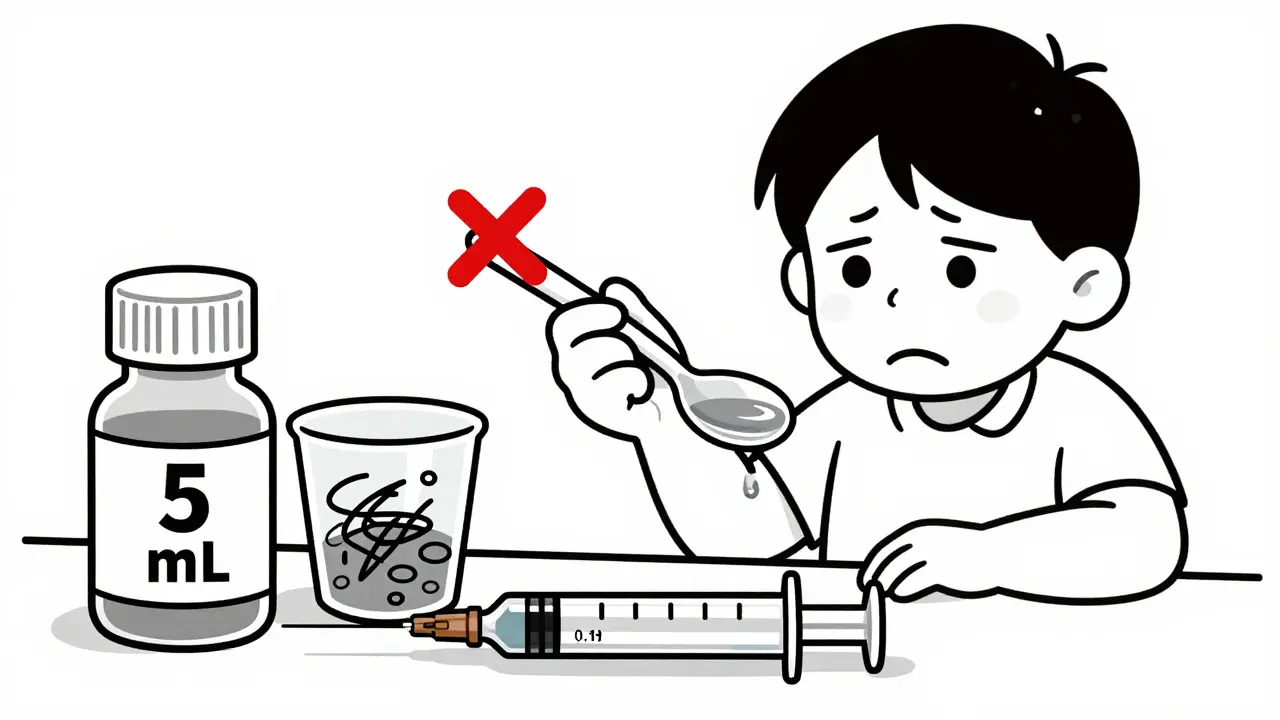
Getting the right dose of liquid medicine isn’t just about reading a number on a bottle. It’s about matching that number with a device that actually measures it correctly. Too often, caregivers use the wrong tool - a kitchen spoon, a dosing cup with too many lines, or even a dirty measuring spoon from the drawer - and end up giving too much or too little. The results can be serious: underdosing means the medicine doesn’t work; overdosing can land a child in the ER. The good news? The science is clear, the tools exist, and the fix is simple if you know what to look for.
Why Dosing Errors Happen
Most liquid medication errors come down to one thing: mismatched tools. A prescription says 5 mL, but the bottle comes with a cup marked in teaspoons. Parents grab a spoon from the kitchen, thinking it’s the same thing. It’s not. A standard teaspoon holds anywhere from 3 to 7 mL depending on how full it is. That’s a 40% error right off the bat. A 2023 study in PubMed found that 15% to 43% of caregivers make clinically significant mistakes when measuring liquids - meaning they give doses that are off by 20% or more. The biggest culprit? Dosing cups. They’re everywhere. But they’re designed poorly. Most have too many markings - eight, ten, even twelve lines - which confuses users. People don’t know where to look. They tilt the cup at an angle, causing parallax error. They read the top of the meniscus instead of the bottom. They fill it to the 5 mL line, but the cup holds 15 mL, so they’re not even close to eye level. One JAMA Network study found that 81% of dosing cups have extra, unnecessary lines that increase the chance of error. Then there’s the unit problem. Labels still say “1 teaspoon” or “2 tablespoons” on older prescriptions. That encourages people to use household spoons. The Institute for Safe Medication Practices says household spoons are responsible for 40% of pediatric dosing errors. Even when a device is included, it often doesn’t match the label. A 2013 study found 89% of products had inconsistencies between what the label said and what the device showed.The Best Tool for the Job: Oral Syringes
If you want accuracy, use an oral syringe. Not the kind you see in hospitals with a needle. The kind with a soft, rounded tip designed for mouths. These are the gold standard for liquid doses under 10 mL - which covers most pediatric medications. Here’s why they win:- They measure to 0.1 mL precision - perfect for doses like 1.6 mL or 2.3 mL.
- They have no parallax error. You hold them straight and read the line at eye level.
- They don’t spill. No drips on the floor or shirt.
- Studies show only 4% error rate for 2.5 mL doses with syringes, compared to 43% with 15-mL cups.
- One 2009 study found 66.7% of users got the dose right with a syringe - only 14.6% did with a cup.
How to Use an Oral Syringe Correctly
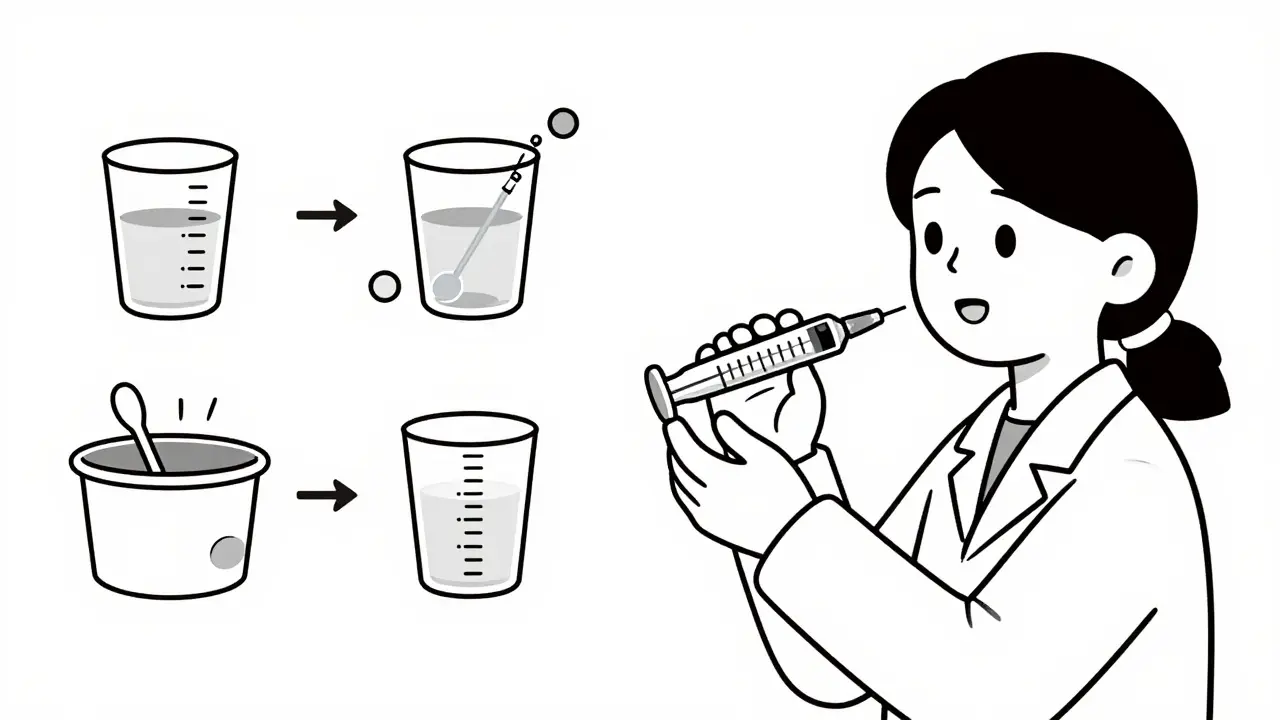
Even the best tool fails if you don’t use it right. Here’s the simple, step-by-step method that works:- Draw air first. Pull back the plunger to fill the syringe with air equal to the dose you’re about to give. This prevents the medicine from sticking to the sides.
- Insert the tip below the liquid surface. Don’t let the tip touch the bottom of the bottle. Keep it submerged.
- Slowly pull the plunger. Stop exactly at the line for your dose. Don’t rush.
- Tap out the bubbles. Gently tap the side of the syringe to make any air bubbles rise to the top. Then push the plunger slightly to push them out.
- Read at eye level. Hold the syringe straight. Look at the line from the side - not from above or below.
- Administer slowly. Gently squeeze the medicine into the side of the mouth, near the cheek. Don’t squirt it down the throat.
What to Avoid
Don’t use these:- Kitchen spoons. Even if you think your teaspoon is “standard,” it’s not. They vary by brand, shape, and how you fill them.
- Dosing cups with too many lines. If the cup holds more than 2-3 times the maximum dose, it’s too big. More lines = more confusion.
- Devices marked in teaspoons or tablespoons. Even if the label says “1 tsp,” ask for a milliliter-only device. The FDA says this encourages unsafe use of household spoons.
- Droppers without clear markings. Some droppers have vague lines. If you can’t tell if it’s 0.5 mL or 0.7 mL, it’s not reliable.
What the Experts Say
The American Academy of Pediatrics has been clear since 2015: “All liquid medications should be dosed exclusively in milliliters.” No teaspoons. No tablespoons. Just mL. Dr. Shonna Yin from NYU found that parents who used milliliter-only labels and devices made 42% fewer dosing errors. That’s not a small difference - that’s life-changing. The FDA’s 2022 guidance says: “mL should be the standard unit of measure.” They also warn that using teaspoons on labels may encourage dangerous behavior. That’s why, as of January 1, 2025, all new liquid medications approved in the U.S. must come with metric-only labeling and matching devices. The United States Pharmacopeia (USP) sets the accuracy bar: any device must be within 10% of the stated volume. Oral syringes almost always meet this. Cups? Often don’t. Spoons? Rarely.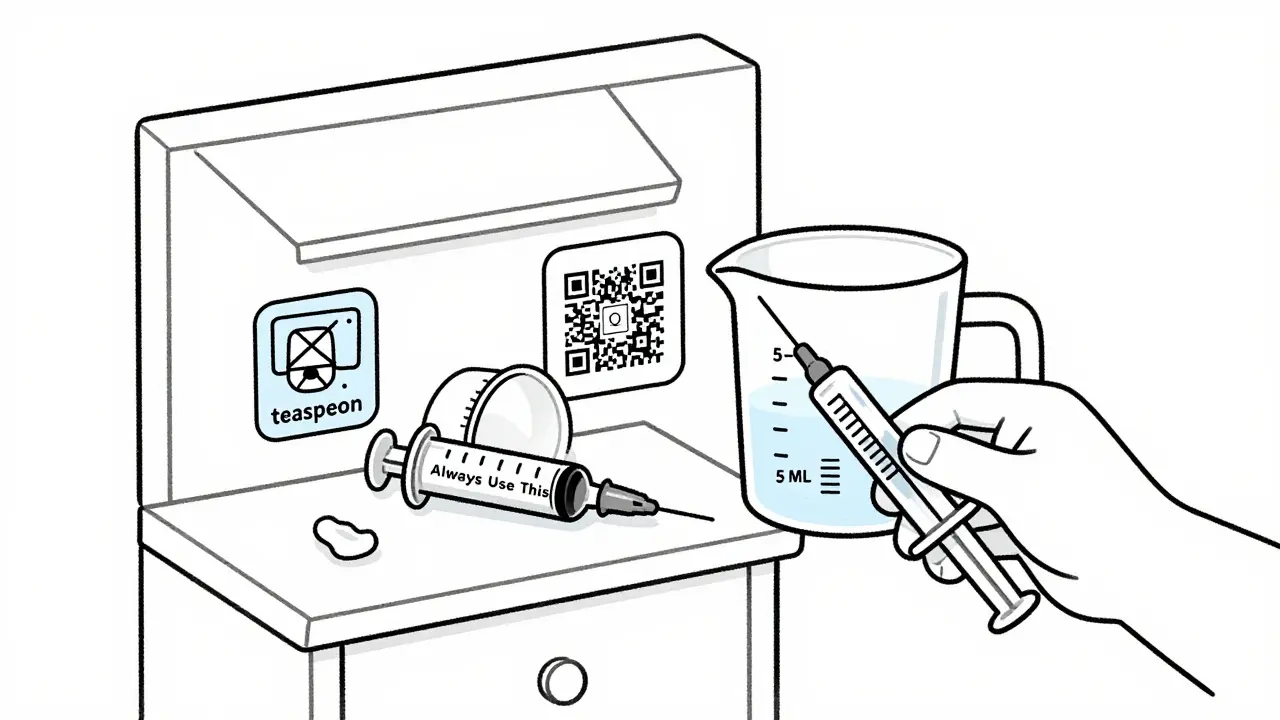
What Pharmacies Should Do
Pharmacists are on the front lines. They’re the last chance to catch a bad dosing setup before it leaves the pharmacy. Best practices:- Always provide an oral syringe for doses under 10 mL.
- For doses over 10 mL, use a dosing cup - but only if it has clear, minimal markings (no more than 3-4 lines) and is marked in mL only.
- Never assume the patient knows how to use the device. Show them.
- Use the “teach-back” method: Ask the caregiver to demonstrate how they’ll give the dose. If they can’t do it right, re-teach.
- Put a QR code on the label that links to a 60-second video showing proper syringe use. Kaiser Permanente did this in 2020 and saw a 25% drop in dosing errors.
What You Can Do Today
You don’t need to wait for a pharmacy to fix this. Here’s your action plan:- When you get a liquid prescription, ask: “Do you have an oral syringe for this?” If they say no, ask them to order one or give you a recommendation.
- Check the label. If it says “teaspoon” or “tablespoon,” ask for a new label with only mL.
- Throw away any dosing cup that has more than four lines or is marked in non-metric units.
- Buy a 5 mL or 10 mL oral syringe from a pharmacy or medical supply store. They cost less than $2. Keep one in your medicine cabinet.
- Practice with water. Do the steps above. Make sure you can measure 1.5 mL or 2.8 mL without guessing.
What’s Changing in 2026
The tide is turning. By 2025, all new liquid medications must follow FDA metric-only rules. CVS and Walgreens now offer apps that pair with Bluetooth syringes to verify doses. Pharmacy chains are rolling out QR codes that show video demos. The European Medicines Agency just released similar rules. But change is slow. In 2023, 28% of liquid prescriptions still used teaspoon labeling. Only 12 states check pharmacy compliance. Low-income families still get lower-quality devices 63% of the time. This isn’t just about technology. It’s about education, enforcement, and equity. But you don’t have to wait for the system to fix itself. You can fix it for your family today.Can I use a kitchen teaspoon if I don’t have a dosing device?
No. Kitchen teaspoons vary in size and are not calibrated. One teaspoon can hold anywhere from 3 to 7 mL. For a 5 mL dose, that’s a 40% error - enough to cause harm. Always use a proper dosing device marked in milliliters. If you don’t have one, ask your pharmacist for a free oral syringe.
Why do some liquid medications come with cups instead of syringes?
Cups are cheaper and easier for pharmacies to stock. They’re also what most people are used to. But research shows cups are far less accurate, especially for small doses. Many pharmacies still use them out of habit, not because they’re better. Always request a syringe for doses under 10 mL - it’s your right.
Are all oral syringes the same?
No. Look for syringes with 0.1 mL markings for pediatric doses. Avoid syringes with needle tips - those are for injections. Use only oral syringes with a soft, rounded tip. Check that the syringe is labeled in milliliters only. Avoid ones with extra markings or plastic caps that make it hard to read.
What should I do if the prescription says 2.5 tsp?
Ask your pharmacist to convert it to milliliters. 2.5 teaspoons equals 12.5 mL. Request a 15 mL oral syringe and confirm the label says 12.5 mL. Never use a kitchen spoon. If the pharmacy refuses to change the label, ask to speak to the pharmacist-in-charge. You have the right to accurate dosing instructions.
How do I know if my dosing device is accurate?
Test it. Fill the syringe or cup to the 5 mL mark. Pour the liquid into a graduated measuring cup you know is accurate (like one used for baking). If it’s within 0.5 mL of 5 mL, it’s acceptable. If it’s off by more than that, throw it out and get a new one. The USP standard allows only 10% error - so 5 mL should be between 4.5 and 5.5 mL.




12 Comments