

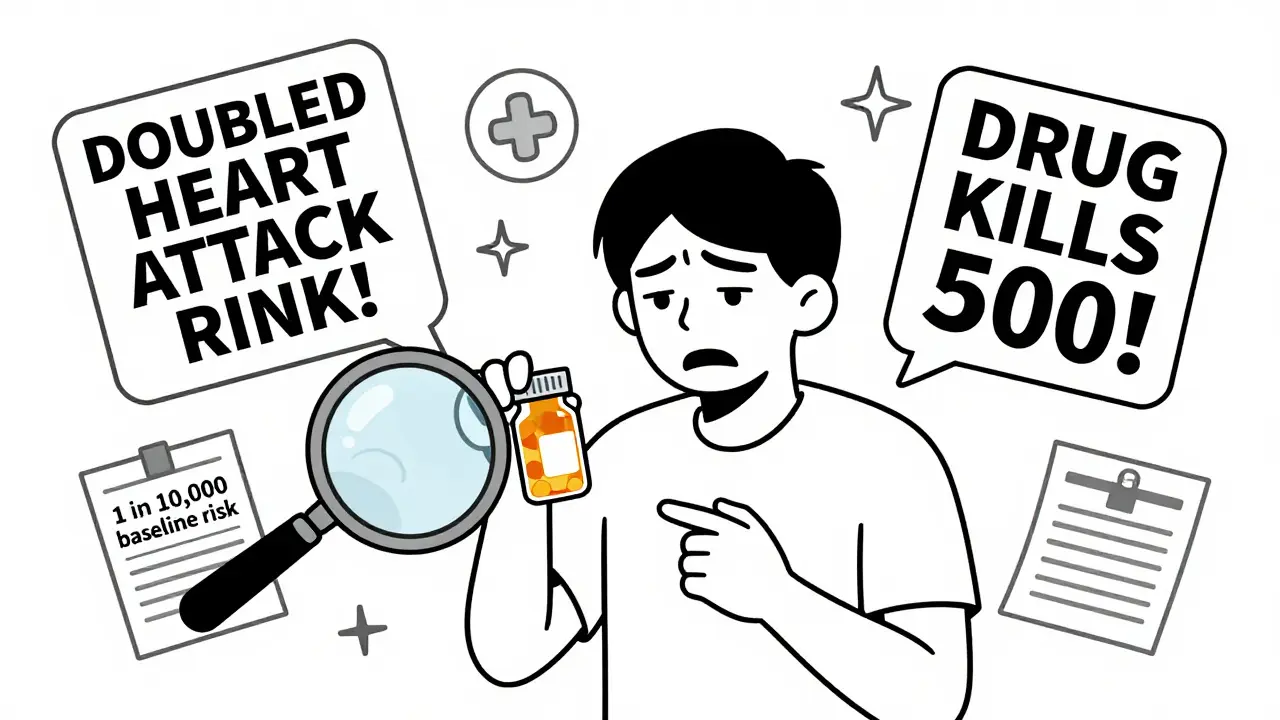
When you read a headline like "New Study Links Blood Pressure Drug to Heart Attacks," it’s natural to panic. You might stop taking your medicine. You might call your doctor in a rush. But what if the story got it wrong? Medication safety reports in the media are often sensational, incomplete, or outright misleading. And the consequences aren’t just anxiety-they can be deadly. A 2023 Kaiser Family Foundation survey found that 61% of U.S. adults changed how they took their meds after reading a news story, and 28% stopped cold. That’s not just fear. That’s a public health risk.
Understand the Difference Between Medication Errors and Adverse Drug Events
Not every bad outcome from a drug is the drug’s fault. A medication error is something that went wrong in the process: a nurse gave the wrong dose, a pharmacist misread the prescription, a doctor prescribed a drug that interacts badly with another. These are preventable. An adverse drug reaction (ADR) is an unintended harmful effect that happens even when the drug is used correctly. Some ADRs are rare but unavoidable-like a severe allergic reaction to penicillin. Many media reports blur this line. A 2021 study in JAMA Network Open found that 68% of news articles didn’t say which type of event they were reporting on. That’s a problem. If a story says a drug caused 500 deaths last year, but those deaths were mostly from errors in nursing homes or pharmacies, the drug itself may be perfectly safe. Always ask: Is this a failure of the system-or the medicine?Check for Absolute Risk, Not Just Relative Risk
Here’s a classic trick: a study might say a drug "doubles the risk" of a heart attack. Sounds terrifying. But if the original risk was 1 in 10,000, doubling it means 2 in 10,000. That’s still extremely rare. Yet 79% of media reports leave out the baseline risk, according to the same JAMA study. A 2020 BMJ analysis of 347 news articles showed that only 38% of digital-native outlets reported absolute risk, compared to 62% in major newspapers. Cable news? Just 22%. Always look for numbers like "1 in 500" or "0.2%"-not just "increased by 100%." If the article doesn’t give you the starting point, it’s hiding the real picture.Know How the Study Was Done
Not all safety studies are created equal. There are four main methods used in real-world drug safety monitoring:- Incident report review: Hospitals and pharmacies voluntarily report bad events. Easy to collect, but only 5-10% of actual errors get reported. It’s like counting missing socks-you only see what’s brought to your attention.
- Chart review: Researchers dig through medical records looking for signs of harm. More thorough, but still misses a lot. Dr. David Bates, who helped develop this method, says these studies typically catch only 5-10% of actual medication errors.
- Direct observation: Someone watches nurses or pharmacists in real time. Most accurate, but expensive and rare in published studies.
- Trigger tool: Uses specific red flags in electronic records (like a sudden spike in potassium levels) to flag possible problems. This is the most efficient method, and it’s the gold standard according to a 2011 systematic review of 28 studies.
Don’t Trust Spontaneous Reports as Proof of Danger
You’ll often see media cite the FDA’s FAERS database or the WHO’s Uppsala Monitoring Centre. These are real, valuable systems-but they’re not designed to prove causation. They collect reports from doctors, patients, and pharmacists. That means a report could say "I took Drug X and had a headache," and it gets logged. But headaches happen all the time. Was it the drug? Or just bad luck? A 2021 study in Drug Safety found that only 44% of media reports understood this. They treated reported incidents like proven side effects. That’s dangerous. For example, if 100 people report a headache after taking a new statin, it doesn’t mean the statin causes headaches-it just means 100 people reported headaches after taking it. The real risk might be zero. Always look for studies that compare users of the drug to non-users. That’s how you find real signals.
Look for Confounding Factors and Limitations
A good study controls for things like age, other medications, smoking, or pre-existing conditions. But a 2021 audit in JAMA Internal Medicine found that only 35% of media-reported studies mentioned controlling for confounding. That’s a huge red flag. Let’s say a report claims a diabetes drug increases stroke risk. But what if most users of that drug are older, sicker, and already at higher stroke risk? Without adjusting for that, the drug looks dangerous when it’s not. A proper study would say something like: "After adjusting for age, kidney function, and use of blood thinners, the risk increase was not statistically significant." If that’s missing, the story is incomplete. Also, check for limitations. Did the study only look at hospitalized patients? Was it only in one country? Was it a small sample? A 2021 JAMA Network Open study found 79% of media reports didn’t mention any limitations. That’s not science-it’s clickbait.Verify Against Trusted Sources
Don’t rely on the news alone. Cross-check with these authoritative sources:- FAERS (FDA Adverse Event Reporting System): Use it to see what’s been reported, but remember-it’s not proof.
- clinicaltrials.gov: Find the original study. Read the abstract. Look for the methods and results sections.
- ISMP (Institute for Safe Medication Practices): They publish a list of error-prone drug names, abbreviations, and dosing mistakes. If a report mentions "Lanoxin" instead of "digoxin," or "U-100" without context, it’s probably sloppy.
- ASHP Guidelines (American Society of Health-System Pharmacists): Their 2023 update outlines what a proper safety monitoring program should include. If a report claims a hospital is unsafe, check if they’re following these standards.
- Leapfrog Group Hospital Safety Scores: If a story says a hospital has dangerous medication practices, see if they’ve been evaluated by Leapfrog. Only 22% of local news reports reference this.
Watch Out for Bias and Commercial Influence
The medication safety monitoring market is growing fast-projected to hit $6.8 billion by 2030. That means money is involved. Pharmaceutical companies fund studies. Media outlets run ads for drugs. A 2023 Health Affairs study found a 300% rise in direct-to-consumer drug ads since 2015, and that’s influencing how safety stories are framed. Some reports will downplay risks if the drug is heavily marketed. Others will exaggerate them to sell supplements or alternative treatments. A 2022 analysis by the National Association of Science Writers found that outlets that consulted ISMP resources had 43% fewer factual errors. That’s a clue: if a reporter reached out to an independent safety group, the story is more likely to be trustworthy. Also, watch for AI-generated content. A 2023 Stanford study found that 65% of medication safety articles written by large language models contained serious errors-especially in risk numbers. If the article feels robotic, vague, or oddly repetitive, it might not be written by a human.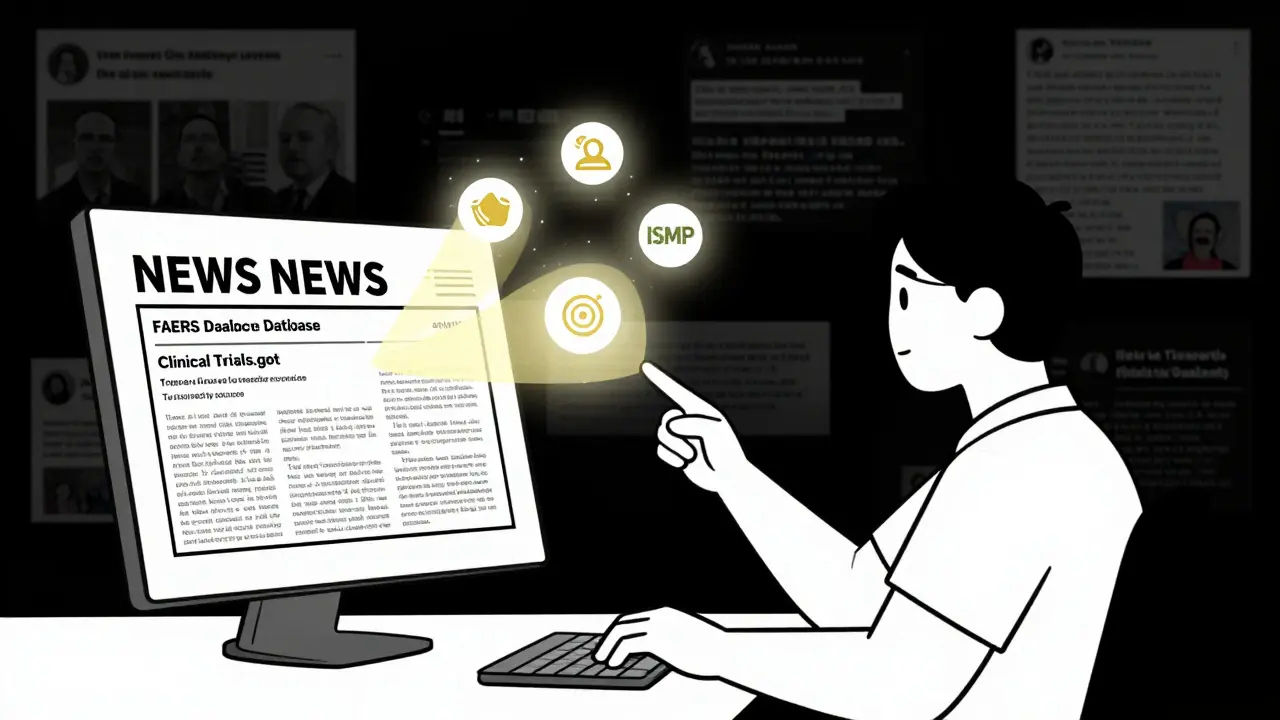
Be Extra Careful on Social Media
Instagram and TikTok are the worst offenders. A 2023 National Patient Safety Foundation analysis found that 68% of medication safety claims on those platforms were wrong. One viral post claimed a common antidepressant caused "permanent brain damage"-but the original study was about rats given 100 times the human dose. Reddit threads like r/pharmacy and r/medicine are better. They’re full of pharmacists and doctors calling out misinformation. If you see a scary post, search those subreddits. Chances are, someone already debunked it.What to Do When You’re Unsure
You don’t need to be a scientist to spot bad reporting. Here’s a simple checklist:- Does the article distinguish between medication errors and adverse drug reactions?
- Does it give absolute risk, not just relative risk?
- Does it name the study method (trigger tool, chart review, etc.) and explain its limits?
- Does it mention confounding factors or study limitations?
- Does it cite FAERS, clinicaltrials.gov, or ISMP?
- Does it avoid phrases like "scientists are alarmed" or "this drug could kill you"?
Final Thought: Trust, But Verify
Medication safety matters. But fear shouldn’t drive your decisions. The system isn’t perfect-reports are messy, studies are complex, and media rarely explains it well. But you don’t need to understand all the science to be smart about it. Just ask the right questions. Look for numbers. Check the sources. Avoid panic. And when in doubt, talk to a professional who sees your full history-not a headline that wants your attention.Can I trust news reports that say a drug is dangerous?
Not without checking the details. Many reports exaggerate risk by using relative risk instead of absolute risk, confuse medication errors with side effects, or misrepresent spontaneous reports as proven dangers. Always look for the study method, baseline risk, and whether confounding factors were controlled.
What’s the difference between FAERS and a real safety study?
FAERS is a database of voluntary reports-anyone can submit a claim. It doesn’t prove a drug caused the event. A real safety study compares people who took the drug to those who didn’t, controls for other health factors, and uses statistical methods to find true signals. FAERS can flag potential issues, but only a proper study can confirm them.
Why do some drugs get pulled from the market after media reports?
Sometimes, media attention pushes regulators to re-examine data. But most drugs aren’t pulled because of a news story-they’re pulled because multiple studies, long-term data, and real-world evidence show a clear, serious risk that outweighs the benefit. Media can accelerate the process, but it rarely causes the decision.
Are newer drugs more dangerous than older ones?
Not necessarily. New drugs go through rigorous testing before approval. The problem is that rare side effects-like 1 in 10,000-only show up after thousands of people use them. That’s why post-market monitoring is critical. Older drugs have more data, but they’re not automatically safer. Both need ongoing evaluation.
How can I find reliable information about my medication?
Start with the FDA’s drug labels, clinicaltrials.gov for original studies, and the Institute for Safe Medication Practices (ISMP) for common error risks. Talk to your pharmacist-they see the real-world use of medications every day. Avoid relying on social media, blogs, or news headlines alone.





15 Comments