

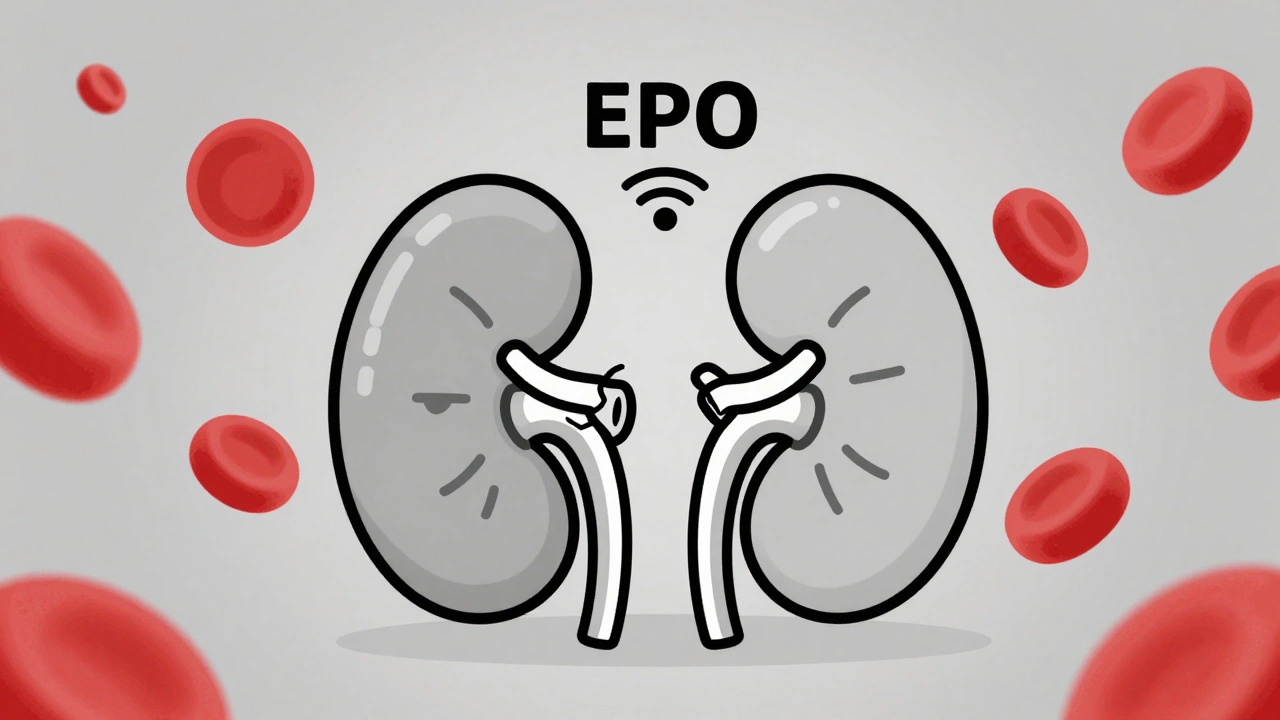
When your kidneys start to fail, they don’t just stop filtering waste-they also stop making a hormone your body needs to make red blood cells. That’s why nearly 90% of people with advanced kidney disease develop anemia. It’s not just feeling tired. It’s struggling to walk up stairs, feeling dizzy when you stand, or watching your grandkids play without being able to join in. This isn’t normal aging. It’s a direct result of damaged kidneys and a broken system that needs fixing-with erythropoietin and iron therapy.
Why Kidney Disease Causes Anemia
Your kidneys make erythropoietin, a hormone that tells your bone marrow to produce red blood cells. When kidney function drops below 30%, that production plummets. But it’s not just about low hormone levels. Inflammation from chronic kidney disease (CKD) blocks iron from moving into your blood, even if you have enough stored. This is called functional iron deficiency. Your body has iron, but it’s locked away, unusable. Add to that poor diet, blood loss during dialysis, and vitamin deficiencies, and you’ve got a perfect storm for anemia.Standard blood tests show low hemoglobin-usually under 12 g/dL for women and 13 g/dL for men. But the real problem isn’t just the number. It’s how you feel. Fatigue, shortness of breath, heart palpitations. These aren’t side effects. They’re symptoms of your body starving for oxygen.
Erythropoietin Therapy: The Hormone Replacement
In the late 1980s, scientists figured out how to make synthetic erythropoietin. Today, we call these drugs erythropoiesis-stimulating agents (ESAs). Common ones include epoetin alfa, darbepoetin alfa, and biosimilars like Retacrit. These aren’t cures-they’re replacements. They mimic your kidneys’ natural signal to your bone marrow: make more red blood cells.For people on hemodialysis, ESAs are usually given intravenously during treatment. For those not yet on dialysis, injections under the skin are preferred. Dosing varies. A typical starting dose for darbepoetin alfa is 0.45 mcg per kilogram of body weight once a week. Most patients see their hemoglobin rise by 1 to 2 g/dL within 2 to 6 weeks.
But here’s the catch: pushing hemoglobin too high is dangerous. Studies like the TREAT trial showed that targeting levels above 13 g/dL increased stroke risk by 32%. That’s why current guidelines, including the 2025 KDIGO draft, recommend keeping hemoglobin between 10 and 11.5 g/dL. Not 12. Not 13. 10 to 11.5. This isn’t arbitrary. It’s based on data from 27 clinical trials showing lower risks of heart attacks, strokes, and death at this range.
Iron Therapy: The Missing Piece
You can give someone the best ESA in the world, and if their iron stores are low, it won’t work. That’s why iron therapy isn’t optional-it’s mandatory before starting ESA treatment.There are two types of iron deficiency in CKD:
- Absolute iron deficiency: Ferritin under 100 mcg/L and transferrin saturation (TSAT) under 20%. Your body is truly out of iron.
- Functional iron deficiency: Ferritin between 100 and 500 mcg/L with TSAT under 20-30%. You have iron, but inflammation keeps it locked in storage.
Oral iron pills? They rarely work in CKD. The gut absorbs only 30-40% of oral iron because of high levels of hepcidin-a hormone that blocks iron release. IV iron bypasses this completely. Iron sucrose, ferric carboxymaltose, and ferumoxytol are common IV options. For hemodialysis patients, 400 mg monthly is a standard maintenance dose unless ferritin exceeds 700 mcg/L or TSAT goes above 40%.
IV iron works faster. A total dose of 1,000 mg can raise hemoglobin by 1.5 g/dL in just four weeks. Oral iron? It might take months, if it works at all. And it causes nausea, constipation, and stomach pain in up to 40% of users. IV iron has side effects too-metallic taste, muscle cramps, or rare allergic reactions-but they’re far less common than GI issues with pills.

What Happens If You Don’t Treat It?
Untreated anemia in kidney disease doesn’t just make you tired. It strains your heart. Your heart has to pump harder to deliver enough oxygen. Over time, this leads to left ventricular hypertrophy-a thickening of the heart muscle that increases risk of heart failure. Studies show that patients with hemoglobin below 9 g/dL have a 40% higher risk of death than those maintained above 10 g/dL.Transfusions were once the go-to fix. But they come with risks: infections, iron overload, immune reactions. And they don’t fix the root cause. ESAs and IV iron do. They restore your body’s natural ability to make red blood cells, not just temporarily replace them.
The New Frontier: HIF-PHIs
A new class of drugs called hypoxia-inducible factor prolyl hydroxylase inhibitors (HIF-PHIs) is changing the game. Roxadustat and daprodustat are oral medications that trick your body into thinking it’s low on oxygen-even when it’s not. That triggers your own natural production of erythropoietin and improves iron absorption.Roxadustat was approved in the U.S. in December 2023 after years of safety reviews. It’s the first oral option for anemia in CKD in America. Early data shows it raises hemoglobin as well as ESAs, with fewer spikes in blood pressure. It also helps move iron into the bloodstream without needing IV doses in some patients.
But it’s not perfect. There are concerns about tumor growth in people with a history of cancer. The FDA placed clinical holds on these drugs between 2018 and 2020 over those fears. Today, they’re used cautiously, especially in patients with active or recent cancer.

Real Patient Stories
A 62-year-old man with diabetic kidney disease had a hemoglobin of 8.2 g/dL. He couldn’t walk to the mailbox without stopping to catch his breath. After starting darbepoetin alfa weekly and IV iron sucrose 200 mg weekly, his hemoglobin climbed to 10.5 g/dL in eight weeks. He started playing with his grandchildren again. He didn’t need a transfusion. He didn’t need a new heart. He just needed the right combination of treatments.Another patient, a 58-year-old woman on dialysis, had tried oral iron for six months. Her ferritin stayed at 80 mcg/L. She switched to IV iron and started darbepoetin. Within six weeks, her energy returned. She started walking daily. Her doctor says she’s one of the 68% of patients who report major improvement in energy within a month of starting treatment.
But it’s not all success. About 10% of patients don’t respond to ESAs. Why? Uncorrected iron deficiency. Ongoing inflammation. Or aluminum toxicity from old dialysis fluids. These patients need deeper investigation-not just more drugs.
What Doctors Look For
Treatment isn’t one-size-fits-all. Doctors check:- Hemoglobin every month
- Ferritin and TSAT before each ESA dose
- Blood pressure regularly-ESAs can raise it
- Signs of heart strain with echocardiograms if needed
They adjust ESA doses by 25% every four weeks based on how hemoglobin changes. If there’s no rise after 12 weeks, they look for hidden causes: infection, hidden bleeding, or vitamin B12/folate deficiency.
Iron therapy is now standard for nearly all hemodialysis patients. In 2010, only 48% received IV iron. By 2022, that jumped to 87%. Why? Because the data proved it works.
What You Should Know
If you have kidney disease and feel constantly tired:- Ask for a complete iron panel-not just hemoglobin.
- Don’t assume oral iron will help. IV iron is often necessary.
- Don’t push for a hemoglobin above 11.5 g/dL. More isn’t better.
- Report any new chest pain, swelling, or headaches. These could be signs of high blood pressure or clots.
- Ask about HIF-PHIs if you’re tired of injections.
Anemia in kidney disease is treatable. It’s not inevitable. The tools are here-erythropoietin, IV iron, and now oral HIF-PHIs. The key is matching the right treatment to the right person, at the right time.
Can I treat anemia in kidney disease with just iron supplements?
No. Oral iron supplements rarely work in kidney disease because inflammation blocks iron absorption. Even if you take high doses, your body can’t use the iron. IV iron is needed to bypass this problem. But iron alone won’t fix low erythropoietin. You need both iron and an ESA-or a HIF-PHI-to rebuild red blood cell production.
Why is my hemoglobin target 10-11.5 g/dL and not higher?
Studies show that pushing hemoglobin above 11.5 g/dL increases the risk of stroke, heart attack, and blood clots. The TREAT trial found a 32% higher stroke risk when targeting 13 g/dL. Higher levels also raise blood pressure, which is already a problem in kidney disease. The goal isn’t to reach normal levels-it’s to reach a level where you feel better without risking your heart.
What are the side effects of IV iron?
Most people have no serious side effects. Common ones include a metallic taste, muscle cramps, or mild flu-like symptoms. Rarely, people have allergic reactions-like hives, low blood pressure, or trouble breathing. That’s why IV iron is given slowly and monitored during infusion. The risk is less than 0.2%. Compared to oral iron, which causes nausea and constipation in 40% of users, IV iron is better tolerated overall.
Is roxadustat safe for everyone?
No. Roxadustat is not recommended for people with active cancer or a recent history of cancer because it may promote tumor growth. It’s also not approved for use in people on peritoneal dialysis in the U.S. Your doctor will check your cancer history and kidney function before prescribing it. For others without those risks, it’s a safe and effective oral alternative to injections.
How often do I need blood tests?
Once you start treatment, you’ll need a hemoglobin test every month. Iron levels (ferritin and TSAT) should be checked every 3 months unless your levels are unstable. If your hemoglobin changes quickly or you start a new medication, your doctor may check more often. Consistent monitoring prevents overdosing on ESAs and avoids iron overload.
Can I stop treatment if I feel better?
Don’t stop without talking to your doctor. Anemia in kidney disease is chronic. Stopping ESAs or iron therapy will cause your hemoglobin to drop again, often within weeks. You may feel fine now, but that’s because the treatment is working. Stopping means returning to fatigue, heart strain, and higher risk of complications. Treatment is usually long-term-sometimes lifelong.
If you’re managing kidney disease and struggling with fatigue, you’re not alone. The science has moved far beyond just “take a pill.” Today, we have targeted therapies that restore your body’s natural balance-without the risks of older approaches. The key is working with your care team to find the right mix for you.




16 Comments